Why St Paul's Organ needs to be restored now
St Paul's Organ is regarded as one of the most versatile instruments of its kind in the region – impressive in sound, technically complex and, by now, visibly showing its age. Prof. Martin Sander, who regularly teaches and performs on it, talks about the instrument’s unique history, about hanging notes, historical stop action mechanisms and the art of the finest tonal nuances. Above all, however, he discusses the musical future of an organ that has accompanied many people for decades.
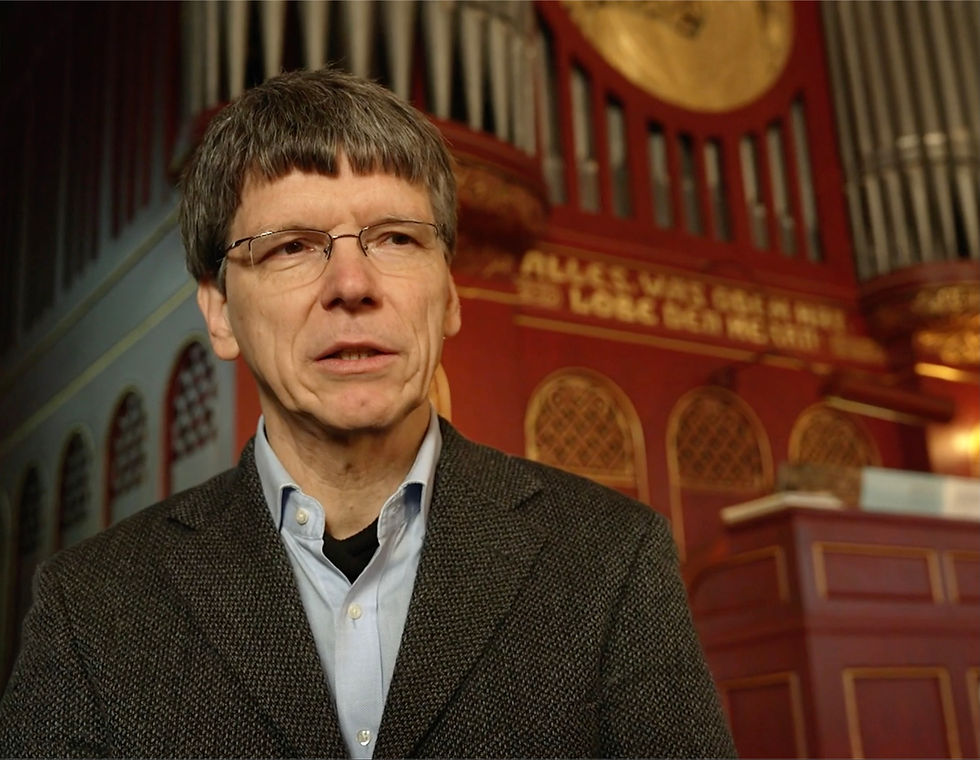
Prof. Martin Sander, Professor of Organ at the Basel Conservatory of Music. Photo by SRF.
Professor Sander, you regularly teach on St Paul's Organ. What makes this instrument so special to you personally?
It is a truly wonderful, successful synthesis of the German Romantic and French symphonic organ styles. The instrument was originally built by Jakob Zimmermann at the same time as the church itself. Jakob Zimmermann was a brilliant organ builder of his day: his instruments had a wonderful sound, but were, unfortunately, always a little unreliable from a technical point of view. That is why there are hardly any of his organs left today; they were all eventually dismantled. Here, it was not demolished, but rebuilt whilst retaining a large part of the pipework – albeit now with reliable technology. Although we will come to the point that technology, of course, does not remain reliable forever either. But in any case, compared to how it probably was originally.
Incidentally, the story is a bit amusing because back then, in south-west Germany and Switzerland, there were actually two major competing organ-building firms: Walcker from Ludwigsburg and Weigle from Echterdingen near Stuttgart. Both also had their Swiss branches: Weigle had Jakob Zimmermann and Walcker had the organ builder Kuhn. And now the funny thing is that Kuhn has breathed new and beautiful life into his great rival’s organ here.
How do your students find playing this organ?
It is not an easy instrument to play. Playing clearly in this room and on this organ is quite a challenge. But challenges are always opportunities for personal growth. That is why we are delighted that this is possible here. And, of course, this instrument is one of the few on which you can play a wide range of the great repertoire.
What is this great repertoire? What kind of music is the organ particularly well suited to?
Take, for example, what we heard in today’s recital: Reger, Karg-Elert, French symphonic music. We heard Tournemire – all of which sounds particularly good on this organ. Of course, an organ that possesses such distinctive qualities on the one hand also presents its own stylistic challenges on the other. When it comes to Baroque music, one has to make a special effort here to ensure it comes across clearly.
The organ is still working, in principle. So why does it need work done on it?
Just yesterday, the organ builder was back again and had to fix a number of stuck notes. One of them was stuck again today, though. It’s a bit like a car: if you don’t keep it in good condition, the repairs become more and more frequent – and at some point you end up spending more money on individual repairs than you would on buying a new car or giving the organ a complete overhaul.
That’s a very clear example. Are there any other situations where you feel that the technology has reached its limits?
It’s actually a miracle that a typesetting system – essentially a computer from the 1990s – still works for the most part today. The problem is: it uses memory cards that, back then, had the very modern and wonderful standard of 32 KB. Of course, you can’t get those anywhere anymore. Nowadays, you get 32 GB. That’s a problem. We have exactly three working cards left. That means we have to see how we can replace them somehow. There’s no chance of getting new ones, and no way of swapping out individual parts either. Nothing fits with that old technology anymore.
Prof. Martin Sander with his former student Aurel Dawidiuk, now Associate Conductor of the Concertgebouw Orchestra in Amsterdam. Photos by SRF.
You mentioned the term ‘setter system’; I’d add ‘register control’ and ‘manubrium magnets’ to that. What do those actually mean in simple terms?
You can think of an organ a bit like an orchestra. We have around fifty different stops here, which are essentially different instruments. In an orchestral score, it specifies when to come in; then you do so – provided you’ve practised and the conductor gives the cue. With the organ, this is handled by the register control. You pull a lever, known as a manubrium. This closes an electrical contact or triggers a signal, which in turn activates a motor that actually switches on the stop. In other words: air is supplied to the stop. This moves a slider with a series of holes in it. When the stop is off, these holes are covered. When they are moved over the air vents of the wind chest, the pipes receive air. That is how the register control works.
When you’re playing yourself, your hands are usually quite busy and you can’t change the stops very often. With Baroque music, this isn’t usually a problem – you might play a Bach piece for ten minutes using the very same sound that you’ve set up beforehand. In Romantic music, however, the sounds are changed more frequently. This requires organists who can quickly pull out or retract each individual stop. This can be made easier if the organ has a setter. You then pre-programme individual combinations – and ‘individual’ here certainly means hundreds of combinations in a single concert. You then start with Group A, Number 1, and from there on, the stopist’s task is simply: on, on, on. This way, you always move on to the next prepared stop setting. That is the function of the setter.
The manubrium magnets are needed because the typesetter doesn’t move the registers by hand. So there needs to be a magnet at the back that can push the register in or out when the setter says: ‘Now the register is in’ – or ‘Now it’s out again’. These manubrium magnets are clearly nearing the end of their service life.
What happens inside the organ during a major overhaul? How should one picture it?
If you look inside an organ, you’ll see a multitude of individual components that are almost impossible to take in at a glance. Everything is connected in some way, and each part has a very specific function. If extra friction occurs anywhere, we end up with a note that gets stuck. I can still force it to play, but the spring that’s supposed to pull it back isn’t strong enough – so it gets stuck. That happens quite often at the moment. During the overhaul, everything is taken apart and checked. Have the plates on which the deflection shafts sit warped, for example? That’s actually the case. Then they need to be smoothed and straightened. Everything is made to work properly again. Basically, you pick up every part and check: Do I need to re-grind anything? Do I need to re-lubricate? There are places where you simply need lubricant. Or is something broken and needs replacing? Quite a few things will need replacing now. You don’t know exactly what beforehand, because to determine that, you’d have to take everything apart already. That would be a huge effort. And then put it all back together again, only to submit the quote afterwards – that would be completely pointless. That’s why the quote ultimately reads: We’ll look at everything and replace whatever is necessary.
Will the sound of the organ change as well?
Not really. Some aspects are likely to become a little more precise, and you’ll certainly notice that. But there aren’t any fundamental changes. That would amount to a complete re-intonation. However, the restoration also involves cleaning, and when you pick up a pipe and clean it, it can of course change slightly. That’s why we go over it again afterwards. But to make these differences truly audible, you’d actually have to make before-and-after recordings of every single pipe. Essentially, it will remain – or become once more – the same beautiful organ, only reliable again for a long time to come.
The organ has recently had a reputation for being somewhat unreliable. Will the instrument be more reliable again for concerts and lessons once the work is complete?
Well – if not, then you’ll have to ask the company for your money back! (laughs) Let’s hope for the best. Because it’s really worth getting hold of this instrument.
In this context, some people might well ask: is there really still a need for such large organs today – particularly in a church that is no longer used as such?
I think there’s often a misunderstanding here: a big organ equals a lot of noise! And then people ask themselves: what’s the point of that? Surely we can manage with less volume. But that’s not the point at all. The point of a large organ isn’t that it’s louder than a small one, but that it offers finer nuances – both in timbre and in volume. The idea behind a large Romantic organ is that, no matter which sound you’re currently playing, you can always add a stop without immediately noticing the difference. The sound becomes slightly louder – or, conversely, slightly quieter – almost imperceptibly. It is only when you reach the very first stops that you really notice: ‘Ah, now we’re going from two to three stops.’ But this very subtle gradation from very soft to very loud – that is the real purpose of a large organ. And you need that for certain repertoire, regardless of the context in which you play it.
To conclude, is there a particular experience you associate with this organ?
Not just one, but quite a few! It would be difficult to single out just one. But it’s quite funny: I’ve known this organ practically since it was built. Back then, I wanted to make a recording, so I drove around to look at various organs. I’d also asked Kuhn if they could recommend an organ – and they recommended this one to me. It had only just been completed back then, in 1987. That’s how I got to know it. In the end, the television programme for which the recording was intended opted for a different venue… but I’ve known this organ ever since and have had a lot to do with it over the years. There have been a number of really great concerts here. I remember, for example, a Messiaen series with Susanne Doll. We played the works together. For a Messiaen concert – really challenging modern music – the place was packed! That interest that we could sometimes spark here – those were real highlights.
What are you personally most looking forward to following the refurbishment?
Here’s to the continuation of all these wonderful things!
The interview was conducted by David Rossel during the general meeting of the Kulturkirche Paulus association in April 2026.
Comments